
Renaud Travadon¹, Florent Trouillas¹ ², Alejandro Hernandez¹ ²
¹Department of Plant Pathology, University of California, Davis CA 95616
²Kearney Agriculture Research & Extension Center, Parlier, CA 93648
Background
In June 2024, a new foliar disease of almond, Red Leaf Blotch (RLB), was detected in Merced County. By the end of summer 2024, RLB presence was confirmed in six counties in the northern San Joaquin Valley. Orchard surveys conducted in 2025 revealed a recent geographic spread of the disease to most almond-producing areas of the state. Cultivars affected by RLB included Aldrich, Butte, Carmel, Fritz, Independence, Monterey, Nonpareil, Padre, Shasta, and Wood Colony. The disease is caused by the invasive fungal pathogen Polystigma amygdalinum and is known as one of the most severe foliar diseases of almond in regions surrounding the Mediterranean Sea. The recent emergence of RLB in California is a serious new challenge for almond growers. The disease only affects leaves, causing obvious and severe symptoms. Severe infections in orchards result in reduced photosynthetic activity, premature tree defoliation during the summer, and depletion in carbohydrate storage, thus impacting tree productivity and orchard yield over several growing seasons. Yield reductions up to 30% have been reported in Spanish orchards.
After one season of field research, the Trouillas Lab at the University of California, Davis developed knowledge of the disease epidemiology and biology and provided disease management guidelines. Of importance, fungicidal products that can prevent effectively the disease and the best timings for fungicide applications were identified.
Disease symptoms and identification
RLB affects almond leaves, causing leaf spots of different sizes and shapes. These leaf blotches are initially yellowish in color, turning orange to reddish-brown as the growing season progresses. The first symptoms can be noticeable in mid to late April, approximately five to six weeks after the initial leaf infections. New symptoms can appear through June on the leaves of actively growing shoots. At advanced stages of disease development, in June and July, leaves become necrotic, curl, and drop prematurely. RLB is caused by P. amygdalinum, an obligate biotrophic fungal pathogen, which is dependent on living plant tissue for growth, reproduction, and feeding and cannot be grown on culture medium. To facilitate diagnosis of RLB and identification of its causal agent, we tested and validated a polymerase chain reaction (PCR) assay (Zúñiga et al. 2018) that uses species-specific primers following DNA extraction directly from leaves. Using similar tools, P. amygdalinum was formally confirmed in 2024 as being present in the state by both CDFA and the USDA.
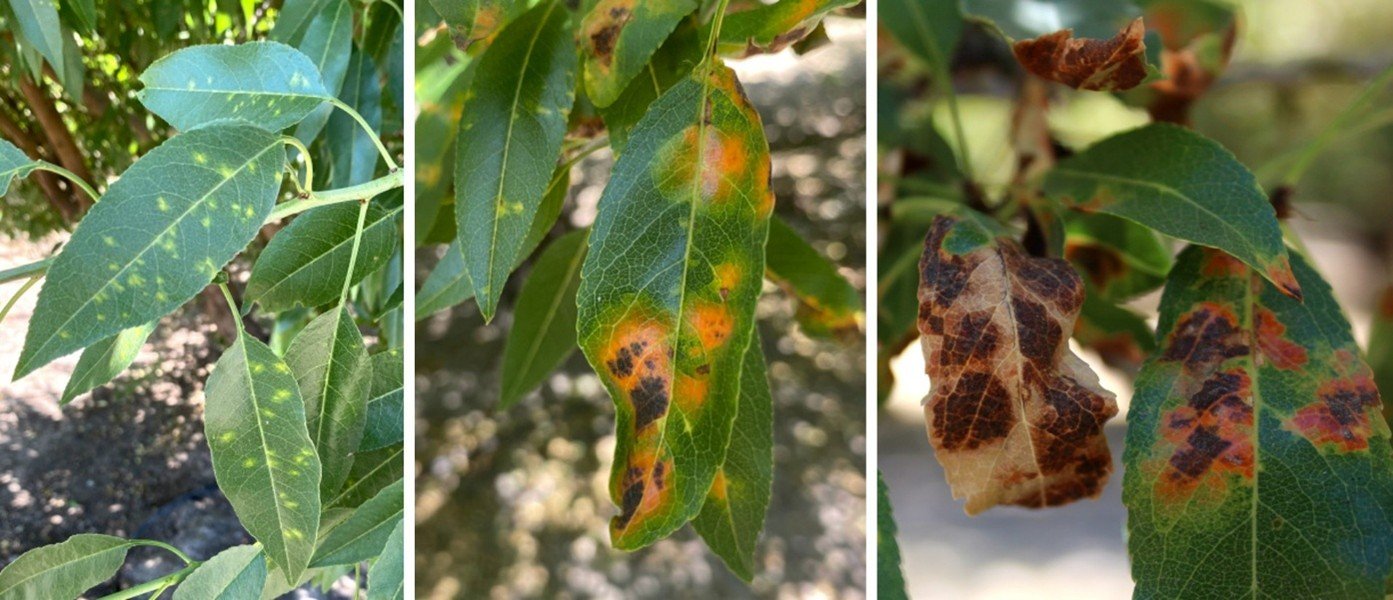
Figure 1. Early symptoms of Red Leaf Blotch include small, pale yellowish spots or blotches (left: early-May). The leaf blotches turn orange to reddish-brown as the season progresses (center: mid-June; right: late July). [Photo credits: Renaud Travadon].
Disease cycle and infection dynamics
The fungus overwinters on fallen infected leaves in the orchard leaf litter. The sexual fruiting bodies of the fungus (perithecia) develop in these leaves during the winter season. These perithecia contain the infectious propagules (ascospores) of the fungus. In the spring, when it rains, ascospores get dispersed from perithecia present in the leaf litter into the air, causing primary infections on newly emerging almond leaves. Spore trapping study in 2025 indicated that the first peak of ascospore release occurred following rain events in late February/early March in the San Joaquin Valley, which coincided with first leaf emergence soon after petal fall. We also observed additional peaks of sporulation during rainfall events in March and late April, confirming that ascospore release is mostly triggered by rain. Overall, our work indicates that infections of almond leaves can occur throughout the spring, primarily during and after rains starting late February/early March until late April/early May.
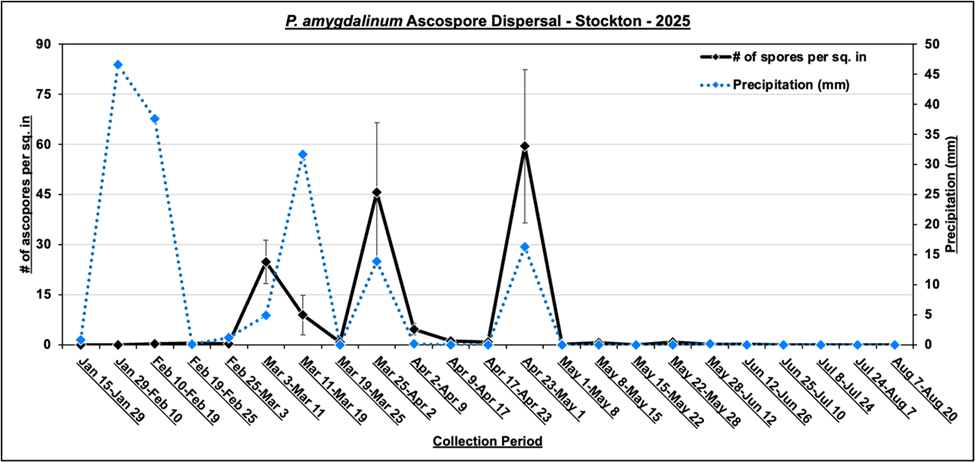
Figure 2. Sporulation dynamics and peaks of sporulation of Polystigma amygdalinum during the 2025 growing season in an almond orchard located in Stockton, California. Peaks of sporulation correlated with precipitation, indicating the optimal timings of fungicide applications prior to rain.
Disease management
The disease has a long latent period of 35 to 40 days, so by the time symptoms are visible, the infection window has long passed. This makes early, preventive management the key to controlling the disease. Based on 2025 field trials and growers’ experience in Spain, a three-spray program is recommended for orchards at risk. The first spray should be applied at petal fall, followed by a second application two to three weeks later, and a third spray five to six weeks after petal fall if wet weather continues. These timings coincide with elevated inoculum levels of P. amygdalinum in orchards and a period of high leaf susceptibility to RLB. Similar timings for fungicide applications are used to manage other spring diseases like scab, shot hole, rust, and anthracnose, highlighting the need for an integrated approach to disease management in almond orchards.
Research trials in 2025 indicated that the most effective products to control RLB included various mixed fungicides with FRAC groups 3 + 7 (e.g. difenoconazole + pydiflumetofen); 3 + 11 (e.g. difenoconazole + azoxystrobin or tebucnonazole + tryfloxystrobin); 7 + 11 (e.g. fluopyram + trifloxystrobin, fluxapyroxad + pyraclostrobin, or boscalid + pyraclostrobin); 7 + 12 (adepidyn + fludioxonil), and FRAC 3-triazoles (metconazole or flutriafol). Growers are advised to rotate modes of action and follow all resistance management and product label guidelines to prevent product failure over time. Cultural practices, focused on eliminating the primary inoculum of infected fallen leaves, also can help mitigate the disease. These consist of removing leaf litter or applying urea to accelerate its decomposition. However, such strategies are only effective when applied over a wide area. Fungicides applied during bloom and after symptoms are visible are not effective.
References
Zúñiga, E., León, M., Berbegal, M., Armengol, J., & Luque, J. (2018). A qPCR-based method for detection and quantification of Polystigma amygdalinum, the cause of red leaf blotch of almond. Phytopathologia Mediterranea, 57(2), 257-268.
Disclaimer: Mentioning of any active ingredients or products is not an endorsement or recommendation. All chemicals must be applied according to the chemical label, local and federal regulations. Please check with your pest control adviser to confirm rates and site-specific restrictions. The authors are not liable for any damage from use or misuse.